Java's Power Tools - A Look at the Collection Framework
Hey Java developers and enthusiasts! If you've been working with Java, you've almost certainly interacted with its powerful and versatile Java Collection Framework (JCF). Whether you're storing a list of user objects, ensuring uniqueness in a set of items, or queuing up tasks, the JCF provides the tools to do so efficiently and in a standardized way.
But what exactly is the JCF, and why is a solid understanding of it so critical for writing good Java code? Let's dive in!
What is the Java Collection Framework?
The Java Collection Framework is a unified architecture for representing and manipulating collections, also known simply as containers. Think of it as a well-organized toolkit of data structures. Every Java engineer has encountered the JCF at some point, and it has enabled us to solve complex problems in an efficient and standardized manner. It's built upon a set of interfaces that define the basic operations for common data structures, and various concrete classes that implement these interfaces to provide specific functionalities.
Core Concepts: Interfaces and Implementations
At its heart, the JCF distinguishes between:
- Interfaces: These are abstract data types that represent different types of collections (like lists, sets, queues). They define what you can do with a collection (e.g., add, remove, iterate).
- Implementations: These are the concrete data structures (classes) that provide the actual mechanics. You choose an implementation based on your specific needs for performance, ordering, or other characteristics.
The Collection Interface: The Foundation Stone
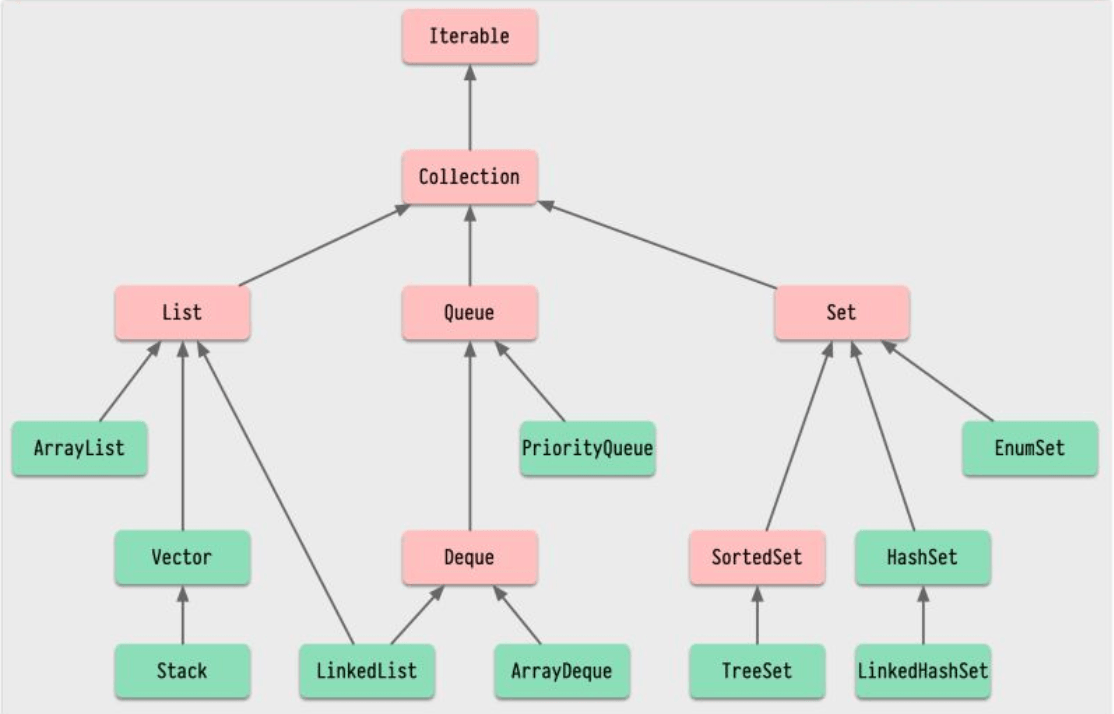
Many of the collections in Java are built upon the Collection interface. This foundational interface:
- Supports basic operations such as adding, removing, and querying elements.
- Crucially, it extends the
Iterableinterface. This is what allows you to conveniently iterate over the elements of any collection using an enhanced for-loop (for-each loop) or by obtaining anIterator.
Key Subinterfaces of Collection
The Collection interface has three main subinterfaces, each serving a distinct purpose:
1. List Interface
- What it is: An ordered collection (also known as a sequence). Lists maintain the insertion order of elements.
- Duplicates: Lists allow duplicate elements.
- Access: Elements can be accessed by their integer index (position in the list).
- Common Implementations: While the source doesn't detail them, familiar examples include
ArrayList(good for random access) andLinkedList(good for frequent insertions/deletions).
2. Set Interface
- What it is: A collection that does not allow duplicate elements. It models the mathematical set abstraction.
- Order: Generally, Sets do not guarantee any specific order of elements (though some implementations like
LinkedHashSetmaintain insertion order, andTreeSetmaintains sorted order). - Common Implementations: Examples include
HashSet(uses hash codes, offers good performance) andTreeSet(stores elements in sorted order).
3. Queue Interface
- What it is: A collection designed for holding elements prior to processing.
- Order: Besides basic
Collectionoperations, queues provide additional insertion, extraction, and inspection operations. Typically, queues order elements in a FIFO (First-In, First-Out) manner. However, there are exceptions likePriorityQueue, which orders elements based on their natural ordering or a suppliedComparator. - Common Implementations:
LinkedListcan also implement theQueueinterface, andPriorityQueueis another key example.
The Curious Case of the Map Interface
Now, you might have noticed something interesting if you're looking at a typical JCF hierarchy diagram: the Map interface isn't a subinterface of Collection. So, what's the deal?
- What it is: While distinct from the
Collectionhierarchy,Mapis a cornerstone of the Java Collection Framework. It represents a collection of key-value pairs. Each key in a map must be unique, and it maps to exactly one value. - Why not a
Collection? TheCollectioninterface deals with a collection of individual elements. AMap, on the other hand, deals with pairs. While you can get a collection of its keys, values, or entries, the map itself isn't a direct collection of single items in the same way aListorSetis. - Common Implementations: Key examples include
HashMap(provides unsorted, unordered mapping, great general-purpose map),TreeMap(maintains keys in sorted order), andLinkedHashMap(maintains insertion order of keys).
Why is Mastering the JCF Essential?
A deep understanding of the Java Collection Framework is non-negotiable for serious Java developers. Here’s why:
- Informed Decisions: Knowing the characteristics of different interfaces and their implementations allows you to choose the most appropriate data structure for your specific problem, leading to more performant and memory-efficient code.
- Efficient Code: Using the right collection for the job can drastically improve performance. For example, using a
HashSetfor checking membership is much faster than iterating through anArrayList. - Maintainable and Standardized Code: The JCF provides a standard way to work with groups of objects, making your code easier for others to understand and maintain.
- Powerful Toolkit: It's a versatile and powerful tool in your Java arsenal, providing ready-to-use solutions for common data management tasks.
Key Takeaways
- The Java Collection Framework (JCF) provides a set of interfaces and classes for representing and manipulating groups of objects.
- Core interfaces include
Collection(and its subinterfacesList,Set,Queue) andMap. Listis ordered and allows duplicates;Setis unordered (usually) and disallows duplicates;Queueis typically for FIFO processing.Mapstores key-value pairs and is not a direct subinterface ofCollection.- Understanding the JCF is crucial for writing efficient, maintainable, and robust Java applications.
The Java Collection Framework is truly a foundational part of the Java language. To really solidify your understanding, there's no better way than to practice using these collections in your projects!